The four Metro Vancouver Boards
Metro Vancouver has four separate legal entities with four boards. These boards provide strategic direction and oversight for Metro Vancouver's services. Membership on each of the four boards is slightly different.
Since: 1967
Legal Act: Local Government Act
Number of directors: 41
Number member jurisdictions: 23
Member: Per the Local Government Act, every local government in a region must be part of a regional district
Services: Air Quality, Regional Parks, Regional Planning, Invest Vancouver, Electoral Area A, Regional Emergency Management, Regional Employers Services**
Since: 1924
Legal Act: Greater Vancouver Water District Act
Number of directors: 38*
Number member jurisdictions: 19
Member: All members except Bowen Island, Lions Bay, and White Rock
Services: Drinking Water
Since: 1914
Legal Act: Greater Vancouver Sewerage and Drainage District Act
Number of directors: 37
Number member jurisdictions:19
Member: All members except Belcarra, Bowen Island, Lions Bay, and scəw̓aθən məsteyəxʷ (Tsawwassen First Nation)
Services: Sewerage and Drainage, Solid Waste
Since: 1974
Legal Act: Business Corporations Act
Number of directors: 41
Number member jurisdictions: 23
Member: All members of MVRD
Services: Non-profit Rental Housing
*Electoral Area A is not a member jurisdiction, but pursuant to the GVWD Act, the Director for Electoral Area A is a voting member of the Board **See Metro Vancouver website for complete list
Board directors are elected by the public to their local councils (or legislature, in the case of Tsawwassen First Nation) and then selected by those councils to serve on Metro Vancouver's boards. The Director for Electoral Area A is directly elected by residents who live there.
Board representation and voting
Each
board director has votes based on the population of the member jurisdiction:
- 1 vote for every 20,000 residents in the community
- At least 1 director for every community
- An additional director for every 100,000 residents
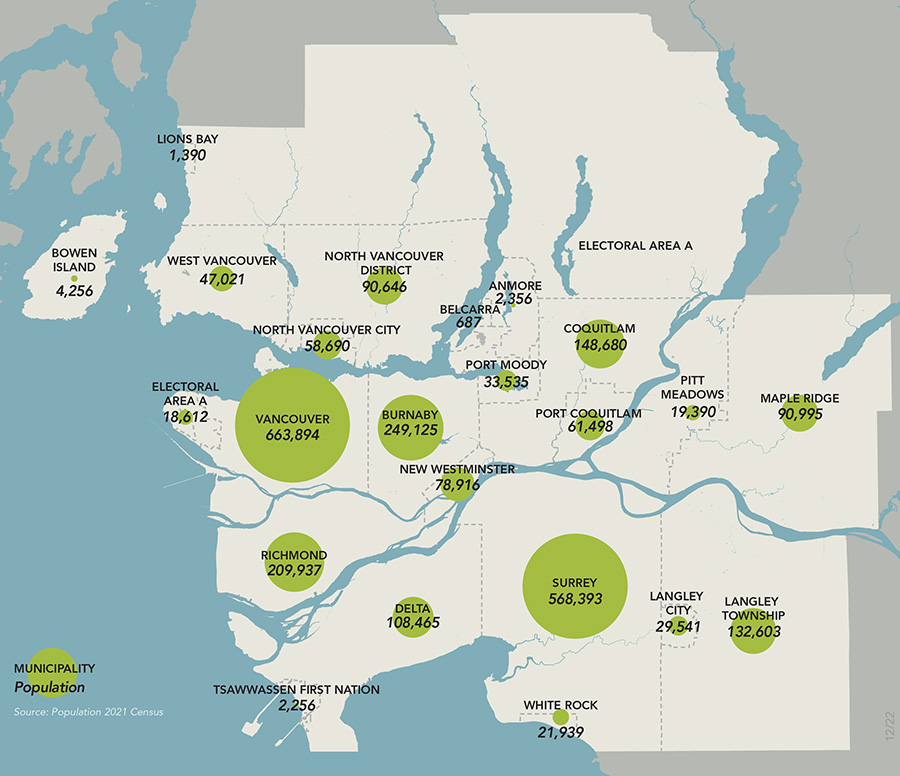
PopulationVotes determined based on the Canadian Census. Current votes based on
2021 Census data.
- Village of Anmore – population 2,356
- Village of Belcarra – population 687
- Bowen Island Municipality – population 4,256
- City of Burnaby – population 249,125
- City of Coquitlam – population 148,680
- City of Delta – population 108,465
- Electoral Area A – population 18,612
- City of Langley – population 29,541
- Township of Langley – population 132,603
- Village of Lions Bay – population 1,390
- City of Maple Ridge – population 90,995
- City of New Westminster – population 78,916
- City of North Vancouver – population 58,690
- District of North Vancouver – population 90,646
- City of Pitt Meadows – population 19,390
- City of Port Coquitlam – population 61,498
- City of Port Moody – population 33,535
- City of Richmond – population 209,937
- City of Surrey – population 568,393
- scəẃaθən məsteyəxʷ (Tsawwassen First Nation) – population 2,256
- City of Vancouver – population 663,894
- District of West Vancouver – population 47,021
- City of White Rock – population 21,939
Metro Vancouver Standing Committees of the Board
Metro Vancouver standing committees advise the board on policy and other matters. Reports from staff most often go first to a standing committee, which considers and discusses the content before forwarding it to the board for decision.
The Board Chair establishes the standing committees and appoints members to them. Members are most often elected officials (eg. mayors and councillors) from member jurisdictions.
Board and committee meetings and reports
Board and committee meetings are open to the public. This makes it easy for residents to see what decisions are being considered and how they are made.
Learn more about upcoming and past meetings: